Showing posts with label books. Show all posts

Sunday, 18 May 2014

Silence Is Deafening, Are My Fears Unfounded? | Nandita Das

Silence Is Deafening, Are My Fears Unfounded? | Nandita Das

The election of a new government in India is the result of a democratic exercise so vast that any critique of the mandate needs to be respectful. And more so, if it is a pre-emptive one. Yet, there are good reasons why some of us are fearful. Let’s begin with the much-proclaimed promise of ‘development’ and the great enthusiasm among the middle and elite classes for the ‘Gujarat model’. Just for the record, the state has always been among the more enterprising and prosperous ones. And in the last decade, even by the simplistic yardstick of economic growth, Maharashtra, Bihar and Tamil Nadu have done better than Gujarat. In any case, economic growth is not the only measure of success, as a large number of Indians are marginalised and suffer on many other counts. Will their voices be heard in an economic model driven above all by corporate policies? Will there be any focus on social measures that are so crucial for the underprivileged? Will the ‘development’ be inclusive and for all?

While we are being asked to move past the 2002 carnage, there is no hesitation in invoking memories of the Partition or going as far back as Babar! What scares me is that let alone any remorse, apology or concern for those whose scars have still not healed, there is a fearful rise in prejudice and its legitimacy. Clearly evident in these elections is a religiously charged ethos, created through the campaign, revealing that under the ‘development’ story the core remains divisive politics. Amit Shah’s speeches in Muzaffarnagar, Modi’s refusal to wear the skull cap, while he wore every other headgear during the campaign, Praveen Togadia asking Muslims to be thrown out of “Hindu areas”, to name a few.Silence Is Deafening, Are My Fears Unfounded? | Nandita Das

Get a Grip — Tips for Safer Driving on Wet Roads


 (NewsUSA) – It’s that time of the year again — time for wetter roads and, unfortunately, more accidents.
Russell Shepherd, a mechanical engineer for Michelin North America and self-proclaimed “tire nerd,” has certainly earned his informal title as evident by his 15 years of driving in almost every type of weather condition imaginable. Most concerning for him — wet weather.
“Most people don’t realize how much wet roads affect their driving,” says Shepherd. “When roads become wet, it takes longer to stop and more time to react, making it more important than normal to pay attention to your car and other drivers.”
So, what can the average driver do? Shepard suggests getting to the bottom of things first — with the tires. Here are some tips:
* Check all tires regularly for tread wear and pressure. Changes in season and temperatures make it a good time to check both.
* Be cautious from the start. As soon as it starts raining, traction can become negatively affected. It only takes a small amount of water to mix with oil and dust to create a slick surface.
* Find the right tire. A tire with a grip designed to handle wet roads, such as the new Michelin Premier A/S tire, can make a big difference. This tire has a unique rubber compound engineered to maximize traction, and two sets of grooves to help channel water away from the tires to maintain that traction. The second set of grooves is hidden when the tire is new, but emerges as the tire wears. This distinctive design feature maintains the tire’s ability to funnel water away, even when worn, which prolongs the life of the tire and enhances driver safety.
* Get in touch with your car. Take time to learn how your car responds on wet roads. Is the steering looser than normal? Are you sliding when you brake? Do you notice the ABS (Anti-lock Braking System) kicking in? If so, your tires could be losing their grip. Slow down and get your tires checked as soon as possible.
For more information about wet-weather driving and choosing the right tire for your car, visit www.michelinman.com/.

Get Ahead of Schedule By Going Tankless


NewsUSA) – With fall in full swing, busy family schedules and the holiday season in the not-so-distant future, homeowners are looking for ways to make their households run more efficiently — sooner rather than later. One way to do this is to educate themselves about tankless water-heating options — before there’s an unexpected problem with an existing storage tank water heater.
“Homeowners tend to forget about their water heater until there’s an issue,” said Kerri Walker, senior marketing manager at Rinnai. “A water heater is a major appliance that can affect your lifestyle for years to come. That’s why it’s important to make the right decision before waking up to find there’s only cold water running through your pipes.”
In most American homes, a 40- to 50-gallon traditional tank water heater stores a limited supply of water that is heated and reheated, even when not in use. This supply can be depleted quickly with heavy hot water usage. A tankless water heater heats water on demand and only as needed, allowing households to shower, bathe and wash clothes and dishes simultaneously or whenever it’s most convenient, rather than being confined to a hot-water schedule.
“Instead of setting an allotted time to run the dishwasher, do the laundry or take showers, a tankless water heater makes it possible to get things done according to your own timetable — without fear that the hot water will run out,” said Walker.
Rinnai tankless hot water heaters have a typical life expectancy of up to 20 years, which far exceeds their traditional water-tank counterparts. Tankless hot water systems are approximately 82 to 96 percent efficient. Additionally, according to energystar.gov, ENERGY STAR-qualified tankless water heaters save an average family more than $100 on their gas bill per year, compared to a standard storage-tank water heater. Depending on the size of your family, you could save even more.
To calculate how much energy your household could save by switching to a tankless water heater, go to www.rinnai.us/tankless-water-heater-energy-savings-calculator.


Monday, 28 April 2014

No Shelf Required With E-Readers at Your Fingertips


With hectic schedules ruling the day, people often underestimate the importance of taking time to relax and recharge—even if for only a few minutes.

To that point, why not do so with a good book? Whether you’re curled up on the couch after work or simply on your lunch break, eReading companies such as Kobo have enough options to keep you interested—and relaxed.
No matter what age you are, there’s something for everyone’s taste or preference.
The 20s can be fraught with stress and tension. You’ve left the comfort of home, so now what? Consider books that will help direct you on your own path. There is “How to Be Interesting” by Jessica Hagy and “The Defining Decade: Why Your Twenties Matter—And How to Make the Most of Them Now” by Meg Jay.
The 30s might have you pondering marriage and family, in which case, “Smart Parenting for Smart Kids: Nurturing Your Child’s True Potential” by Eileen Kennedy-Moore and Mark S. Lowenthal might be informative and invaluable reads. For a mind-candy read that’s sure to entertain, try “Bridget Jones’s Diary” by Helen Fielding.
By their 40s, people are looking for a little romance or a thrill. Books such as “Inferno” by Dan Brown, or “Committed” by Elizabeth Gilbert may have just the appeal you’re looking for.
In your 50s, the kids are (hopefully) out of the house, and you now have time to read and travel. To that end, “Still Alice” by Lisa Genova and “Live By Night” by Dennis Lehane could be the thing to toss in your suitcase.
The 60s, or Golden Years, mean retirement and the ability to enjoy the things you love most. Whether it’s spending time with family, keeping fit, or curling up with a good book, there is “Beautiful Ruins” by Jess Walter or “Paris” by Edward Rutherfurd.
As well as offering instant access to millions of titles online, digital reading companies offer a cornucopia of eReading device options and free reading apps for most smartphones and tablets, making it easy to expand your “just read” list. Whatever your age—young or old, married or single—books are a source of entertainment, escape and inspiration, but most of all, enjoyment.
Learn more at www.kobo.com/ereaders.

Saturday, 5 April 2014

KHAIRLANJI; A Strange and Bitter Crop – Anand Teltumbde


Small village in Bhandara district in Maharashtra has been focus of attention when four member of one dalit family was slaughtered on 29th September 29th, 2006 in bhandara district. Victims are Bhaiyyalal Bhotmange’s wife surekha, 44, his daughter priyanka, 18, sons, roshan, 23, and sudhir, 21.The fact finding team of vidarbha Jan Andolan Samiti visited on 6th October to village kherlanji to know the details of this barbaric killing and they were shocked to learn that, Bhaiyyalal`s wife surekha, 44, his daughter priyanka, 18, sons, roshan, 23, and sudhir, 21, were first stripped naked, dragged from their hut to the choupal 500 meters away and hacked to death by the entire village of the so called upper-castes. vJAS has moved with the fact finding committee report to national human rights commission(nhrc) for independent probe of this dalit massacred as all political parties and local administration are covering up the matter as till date no mla or mp from bhandara has visited the village or Bhaiyyalal, more than a week after the gruesome killing took place. Two mlas from Nagpur, ostensibly sent by the congress higher-ups, visited kherlanji, but did not make any noise. The police are not acting fast and the only two prime witnesses are under threat. Not a single villager’s statement has been recorded. Neighboring villages are living with fear and terror, especially the minority lower castes dalit to dared to demand the right of land were slaughtered in order to give other dalit in villages of Mowadi taluka of bhandara district.

Anand Teltumbde gives the full accounts of that massacre which shook the world, in the book  “KHAIRLANJI A Strange and Bitter Crop”. He wrote; when the Khairlanji killing took place in September 2006, India was daydreaming about becoming a superpower. Clocking an average of eight percent GDP (Gross Domestic Product) Growth over the previous three years, it was expected to surge to a double-digit growth. The swelling of foreign exchange, influx of portfolio investments, a sky rocking sensex, booming business, merges and acquisitions by Indian corporate, the growing numbers of Indian Billionaires  - the entire establishment was singing the song of India. It was being said that India would soon overtake China. As this India of a handful people rose, the other India of hundreds of thousands was plumbing new lows…

Arundhathi Roy wrote; Anand Teltumde’s analysis of the public, ritualistic massacre of a dalit family in 21st century India exposes the gangrenous heart of our society.  It conceptualizes the massacre and describes the manner in which the social, political and state machinery, the police, the mass media and the judiciary all collude to first create the elimate for such bestiality, and then cover it up. This is not a book about the last days of relic feudalism, but a book about what modernity means in India. It discusses one of the most important issues in contemporary India.

Friday, 4 April 2014

Private and Public Slaves – Ravikumar.


Ravikumar
In a contest where dalit writing is being equated only with autobiography, we present here in book from notes written by B R Ambedkar,which have the characteristics of autobiographical writings. In multi volume writings and speeches of Babasaheb Ambedkar edited by Vasant Moon, these writings can be found in Volume 12, under the title ‘Waiting for a Visa’. The connection between the title and the six autobiographical ‘illustrations’ – as Ambedkar calls them – is not clear. Perhaps, Ambedkar indented adding more to this body of writing but eventually could not. All that the editorial note by Moon says is: “Here are some of the reminiscences drawn by Dr. Ambedkar in his own handwriting. The MSS traced in the collection of the People’s Education Society were published by the society as a booklet on 19th March 1990. – ed.” If these are some reminiscences, were there more? What Visa was Ambedkar waiting for? We can, however, gather frome the content that Ambedkar wrote at least a few of these available notes in 1935. In the second reminiscences, he refers to his return from London to work in Baroda in 1917. towards the end of this section, he recalls that “18 years has not succeeded in fading away” the memory of the incidence of untouchability he experienced in the Parsi inn. The last ‘illustration’ refers to an incident that happened in march 1938, and must have been written well after that. It is clear that Ambedkar jotted down several such ‘illustrations’ over the years, and perhaps many have been lost. In this edition, we have given separate titles to each episode that Ambedkar recalls, instead of numbering them as in the original.

Though Ambedkar’s works are available volumes, and despite the availability of biography by Dananjay Keer (Dr.Ambedkar: Life and Mission, 1954), and two feature films on the man (Jabbar Patel’s Babasaheb Ambedkar in Hindi, 2000; and Dr Padmavathi-Bharath’s Ambedkar in Telugu, 1992), we learn very title about this personal life. What we know of Ambedkar pertains solely to his public life, his public self. Other than occasional reference to his poor helth in his writings, speeches and letters, it has not been possible for us to know anything about the sorrows and joys that came his way. How was his marital life; what was the nature of his relationship with his son; the kind of friendships he had – we know little about these.

Ambedkar emphasized the role of the individual in society. He was someone who waged a hard battle during the drafting of the Indian Constitution to centralize the individual in its frame work. He also accepted the contribution of the individual to the making of history. However he did not leave behind anything his writing for us to understand and approach him as an individual.

The issues that confront dalits can be understood through the binary of the public and the private. The public has come to connote things and space which are inaccessible for the dalits. Common wells, public roads and cremation grounds are space denied to dalits. If a dalit does well in the open competition of an entrance exam, she is often slotted in the reserved category. In electoral politics, a dalit is not expected to contest from a general constituency. Whatever the law – ironically drafted by Ambedkar – says, this is the reality.

The purpose of Hindu politics has been to restrict and relegate dalits to the ‘reserved’ sectors. The dalits have to defy such social strictures to enter the public sphere. This is a difficult process. Even as we infiltrate these common spaces, we need to retain our singularity, individuality. The process is a problematic as the state of mind of a dalit person who has o make sure he does not touch any other person in the village and also remain untouched by others, and yet is forced to consider the village as his own (‘native place’). In this struggle, there is pressure on dalits to merge the specificities of their selfhood into the collective identity of the (dalit) community.

In the struggle that let to his emergence as the spokesperson and symbol of a community, Ambedkar’s personality has merged into a larger collective, public self. Only when a comprehensive biography is written can Ambedkar’s individual self be reclaimed. The several facts of his personality, if collected, could also be useful for the dalit struggle.

These autobiographical notes, written with the objective of enabling foreigners to understand the practice of untouchability, are relevant even today. The atrocities and the justices continue, and so does the indifference.

To think that one could eradicate untouchability while remaining within Hinduism is similar to the attempt to clean sewage with ditchwater. How long will we resist the clear water of democracy?

Pondichery
!5 October 2003.


Wednesday, 2 April 2014

Shape Yourself Into a Master Salesperson


NewsUSA) – Even if you’ve never so much as sold candy door-to-door for a school fundraiser, you have sales experience. You sell an idea when you persuade someone to your point of view or an image when you meet someone for the first time. So, even if you don’t plan on becoming a professional salesperson, you adapt some of the traits of a master salesperson.
“I’ve met a tremendous amount of talented, successful people. They’ve taught me a great deal, and I’ve appreciated every one of them,” said the late Paul J. Meyer, author of “Pink Slip Proof: How to Control All Future Paychecks.” “When you look closely, it’s no secret how they arrived at their present income and position.”
In his book, Meyer listed five basic qualities shared by every master salesperson:
1. All master salespeople are persuasive and convincing. The ability to persuade isn’t limited to leaders — any time you help someone see something your way, you have made a sale. Top salespeople use every technique at their disposal, including stories, dreams, color and humor.
2. All master salespeople focus on service. Meyer cited the “golden rule” of service — serve others as you would like to be served. A salesperson who goes out of their way to focus on service will likely win their customers’ loyalty.
3. All master salespeople are honest. If you’re a known liar, no one’s going to trust you enough to buy what you’re selling. “Top salespeople are honest, keep their word, work hard, are responsible, incredibly dependable and act with complete integrity in all they do,” said Meyer.
4. All master salespeople are self-motivating. Master salespeople motivate themselves to accomplish goals, no matter how they feel or what other people say. “Self-motivation requires the development of inner strength, conscious will power, overwhelming desire, and the determination to reach any goal you personally want to achieve,” said Meyer.
5. All master salespeople care about other people. The best salespeople genuinely want to leave their clients better off than they found them — they’re not selling to make money, but to give their clients a needed product or service.
For more tips from Paul J. Meyer, purchase the book “Pink Slip Proof: How to Control All Future Paychecks.”

The original Disciples of Sreepadmanabha Temple of Kerala is Dalits ! - Edward Thurston

The original Disciples of Sreepadmanabha Temple of Kerala is Dalits ! Edward  Thurston realize with historical evidences. The note is taken from his book “Caste and Tribes of South India. Printed in the year 1909,at  Government Press Madras. Vol No. II page No .46 – 49.

The Cherumans or Cherumukkal have been defined as a Malayalam caste of agricultural serfs,and as members of an inferior caste in Malabar, who are, as a rule, toilers attached to the soil. In the Madras Census Report, 1891, it is stated that "this caste is called Cheruman in South Malabar and Pulayan in North Malabar. Even in South Malabar where they are called Cheruman, a large sub-division numbering over 30,000 is called Pula Cheruman. The most important of the sub-divisions returned are Kanakkan, Pula Cheruman, Eralan, Kudan and Rolan. Kanakkan and Pula Cheruman are found in all the southern taluks, Kudan almost wholly in Walluvanad, and Eralan in Palghat and Walluvanad." In the Census Report, 1901, Alan (slave), and Paramban are given as sub-castes of Cheruman.

According to one version, the name Cheruma or Cheramakkal signifies sons of the soil ; and, according to another, Cheriamakkal means little children, as Parasurama directed that they should be cared for, and treated as such. The word Pulayan is said to be derived from pula, meaning pollution.

Of the Cherumans, the following account is given in the Gazetteer of Malabar. " They are said to be divided into 39 divisions, the more important of which are the Kanakka Cherumans, the Pula Cherumans or Pulayas, the Era Cherumans or Eralans, the Roli Cherumans or Rolans, and the Kudans. Whether these sub-divisions should be treated as separate castes or not, it is hardly possible to determine ; some of them at least are endogamous groups, and some are still further subdivided. Thus the Pulayas of Chirakkal are said to be divided into one endogamous and eleven exogamous groups, called Mavadan, Elamanam, Tacchakudiyan, Kundaton, Cheruvulan, Mulattan, Talan, Vannatam, Eramalodiyan, Mullaviriyan, Egudan, and Kundon. Some at least of these group names obviously denote differences of occupation. The Kundotti, or woman of the last group, acts as midwife ; and in consequence  group is considered to convey pollution by touch to themembers of the other groups, and they will neither eatnor marry with those belonging to it. Death or birth pollution is removed by a member of the Mavadan class called Maruttan, who sprinkles cowdung mixed with water on the feet, and milk on the head of the person to be purified. At weddings, the Maruttan receives 32 fanams, the prescribed price of a bride, from the bridegroom, and gives it to the bride's people. The Era Cherumans and Kanakkans, who are found only in the southern taluks of tiie district, appear to be divided into exogamous groups called Kuttams, many of which seem to benamed after the house-name of the masters whomthey serve. The Cherumans are almost solely employed as agricultural labourers and coolies ; but they also make mats and baskets."

It is noted * by Mr. L. K. Anantha Krishna Iyer that M from traditions current among the Pulayas, it would appear that, once upon a time, they had dominion over several parts of the country. A person called Aikkara Yajaman, whose ancestors were Pulaya kings, is still held in considerable respect by the Pulayas of North Travancore, and acknowledged as their chieftain and lord, while the Aikkaranad in the Kunnethnad taluk still remains to lend colour to the tale. In Trivandrum, on the banks of the Velli lake, is a hill called Pulayanar Kotta, where it is believed that a Pulaya king once ruled. In other places, they are also said to have held sway. As a Paraya found at Melkota the image of Selvapillai, as a Savara was originally in possession of the sacred stone which became the idol in the temple of Jaganath, so also is the worship of Padmanabha at Trivandrum intimately connected with a Pulayan. Once a Pulaya woman, who was living with her husband in the Ananthan kadu (jungle), suddenly heard the cry of a baby. She rushed to the spot, and saw to her surprise a child lying on the ground, protected by a snake. She took pity on it, and nursed it like her own child. The appearance of the snake intimated to her the divine origin of the infant. This proved to be true, for the child was an incarnation of Vishnu. As soon as the Raja of Travancore heard of the wonderful event, he built a shrine on the spot where the baby had been found, and dedicated it to Padmanabha. The Pulayas round Trivandrum assert to this day that, in former times, a Pulaya king ruled, and had his castle not far from the present capital of Travancore. The following story is also current among them. The Pulayas got from the god Siva a boon, with spade and axe, to clear forests, own lands, and cultivate them. When other people took possession of them, they were advised to work under them."

According to Mr. Logan,* the Cherumans are of two sections, one of which, the Iraya, are of slightly higher social standing than the Pulayan. " As the names denote, the former are permitted to come as far as the eaves (ira) of their employers' houses, while the latter name denotes that they convey pollution to all whom they meet, or approach." The name Cheruman is supposed to be derived from cheru, small, the Cheruman being short of stature, or from chera, a dam or low-lying rice field. Mr. Logan, however, was of opinion that there is ample evidence that " the Malabar coast at one time constituted the kingdom or Empire of Chera, and the nad or county of Cheranad lying on the coast and inland south-east of Calicut remains to the present day to give a local habitation to the ancient name. Moreover, the name of the great Emperor of Malabar, who is known to every child on the coast as Cheraman Perumal,was undoubtedly the title and not the name of the Emperor, and meant the chief (literally, big man) of the Chera people."


Book: “The Scar” A Dalit’s Autobiography by K A Gunasekharan.


Growing up as a boy from the Parayar caste, in the milieu of Christian, Hundu and Muslim communities., K A Gunasekharan narrates the familiar tale of caste oppression and prejudice prevalent in the villages of Tamil Nadu. As the narrative unfolds, the reader is shown how the ‘low’ caste negotiates differently with the three religious communities. The deep pain of the Paraya surfaces through the risible anecdotes that ridicule the grievously unjust practices of the ‘upper’ castes.

The book emphasises the fact that Indian villages are doubly caste-consious and cruel, and that Dlit emancipation rests in better education for the community. Gunasekharan writes in an earthy and colloquial style to capture the innocence, cruelty and drama of a south Indian village.

Considered the first modern autobiography in Tamil, ‘TheScar’ (Vadu) is an importance book calling for Dalit assertion and emancipation.


K A Gunasekharan is a teacher, folk-artist dramatist and researcher. He was the dean of the School of Performing Arts at Pondichery University. Currently he is the Director of the  international Institute of Tamil Studies. In preface of the book, he says:


My early days are closely associated with the people of Islam. I realized even whilw at school, that caste differences did not exists in Elayankudi -  a place with a large Muslim population, whereas in places just two kilometers away, it was found in excess. I contemplated the horrid experiences I have had because of caste discrimination in my early life. ‘Vadu’ (Scar) evolved. Anger welled up as I wrote about the discriminatory practices that I ha suffered; sometimes tears flowed. I have captured in my writing all the experiences that I narrated to my friends on various occasions.


Kalikulam village is near Thayamangalam. This is where my friend Samidoss was born. I had an unforgettable experience when I stayed there one night. At around midnight, a kudukkuduppaikkaran entered a cheri making the eeri rattling sound peculiar to this tribe.

I wake up even as he entered the street. I told Samodoss, Die! I will hide in the cattle shed opposite your house. I want to sea how this fellow makes his appearance. Samidoss warned me saying, ‘ He will bring the ghosts with him. He will incapacitate you’ I decided to comfort him and did himself in the cattle shed. Samidoss lay frozen with fear.

The kudukuduppaikkaran stood at the entrance shouting, ‘Thoo, thoo, thoo, graveyard hag.’ The entire village was quavering with fear, I think. None came out. I got up quickly, folded my kaili, and left in a huff without finishing his oracles for the entire street, shouting and threatening, ‘Thoo, thoo, thoo… something bad is going to happen to this house.’

KIn Salaiyur, during Ramsan, the fakirs would go around the Muslim streets, singing to the accompaniment of beats kept by a small drum. I used to stay awake to watch them. I think it is this habit that helped me to accost the kudukududppaikaran in Kalaikulam.

Like this there are so many anecdotes, which come to mind on and off. There are many incidents, which have been left out. I have written about only a few of them in Vadu.

When I read parts of what I had written to Elengo teacher, he felt us through it was his own experiences that were being narrated. Comrade A Marx encouraged me to compile my experiences.

Comrade Ravikumar published an expert from Vadu in Dalit Murasu magazine. It was well received. In order to bring  it out as book I send a soft copy of Vadu to Kalachuvadu.

I had the unique privilege of having Prof.Nanjundan as the editor of my book. He gave me useful suggestions to bridge the gap between my style and the counter. Our meeting at Salem and the discussion I had with him helped in making Vadu understandable to all readers, without compromising the language of my soil. His knowledge of Grammatical Tamil without my formal training in it is impressive.

I have related my experience up to my college days in this account. The experience I Have had since the time, my involvement in Marxist movements, my journey down the arts lane, do not figure in this book. Dalit youngsters who read Vadu may be inspired to realize that they need to fight this caste-ridden society with more energy than the others do. For the others, this book is an introduction to dalit life.

While proof reading, my wife Revathi’s constructive criticism of my style of writing as very useful. To her and to Comrade A Marx, I owe my gratitude. I am grateful to my friend, Nanjundan, Comrade P Panchangam, Dr. A Thirunagalingam, a friend from my childhood days (who remained me of the many experiences that I had felt out) and Karasur Palanichami.

I also thak Ravikumar for his erudite preface, and Kalachvadu Publishers.

K A Gunasekharan
20 December 2004
Pondichery.

This preface is translation from the Tamil edition. Translated by V Kadambari, who teaches  English at the Ethiraj College of Woman, Chennai. She is a blingual writer and translator, and keenly interested in gender issue and gender studies.

The book is published by Orient Blackswan private limited.WWW.orientblackswan.com


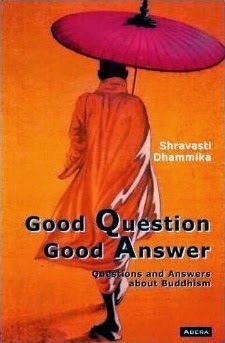
Buddhism: Good Question, Good answer – Ven S Dammika.


What is Buddhism?

The name of Buddhism comes from the word ‘Budhi’ which means ‘ to wake up’ and the Buddhism is the philosophy of awakening. The philosophy has its origin is the experience of the man Siddhata Gautama, known as the Buddha, who was himself awakened at the age of 36. Buddhism is now 2,500 years old and has about 300 million followers world-wide. Until a hundred years ago, Buddhism was mainly an Asian philosophy but increasingly it is gaining adherents in Europe and America.

So Buddhism is just a philosophy?

The word philosophy comes from two words ‘philo’, which means ‘love’, and ‘Sophia’ which means ‘wisdom’. So philosophy is the love of wisdom or love and wisdom both meaning describing Buddhism perfectly.  Buddhism teaches that we should try to develop our intellectual capacity to the fullest so that we can understand clearly. It also teaches us to develop love and kindness so that we can be like a true friend to all beings. So Buddhism is a philosophy but not just a philosophy. It is the Supreme philosophy.

Who was the Buddha?

In the year 563 BC a boy was born into a royal family in Northern India. He grew up in wealth and luxury but eventually found that worldly comfort and security do not guarantee happiness. Ha was deeply moved by the suffering he saw all around – and resolved to find the key to human happiness. When he was 29 he left his wife and child and set off to sit at the feet of the great religious teachers of the day to learn from them. They taught him much but none really knew the cause of human sufferings and how it could be overcome. Eventually, after six years study and meditation he had to experience in which all ignorance fell away and he suddenly understood. From that day onwards, he was called Buddha., the Awakened One. He lived for another 45 years in which time he traveled all over Northern India teaching others what he had discovered. His compassion and patience were legendary and he made thousands of followers. In his eightieth year, old and sick, but still happy and at peace, he finally died.

Was the Buddha a God?

No, he was not. He did not clime that he was a god, the child of a god, even the messenger from a god. He was a man who perfected himself and taught that if we followed his example, we could perfect ourselves also.

If the Buddha is not a god, than why do people worship him?

There are different type of worship. When someone worship a god, the praise and honor him or her, make offering and ask for favors, believing that god will hear their praise, receive their offerings and answer their prayers. Buddhists do not indulge in this kind of worship.

The other kind of worship is when we show respect to someone or something we admire. When a teacher walks into the room we stands up, when me meet a dignitary we shake hands, when the national anthem is played we salute. These are all gusters of respect and worship and indicate our admiration for person or things. This is the type of Worship Buddhist practice. A statue of Buddha with its hands rested gently in its lap and its compassionate smile reminds us to strive to develop peace and love within ourselves. The perfume in incense reminds us of the pervading influence of virtue, the lamp reminds us of the light of knowledge and the flowers, which soon fade and die, remind us of impermanence. When we bow, we express our gratitude to the Buddha for what his teachings have given us. This is the nature of Buddhist worship.


The Book was first written in 1987 in response to the increasing interest in Buddhism amongst Singaporeans. To my surprise and delight, it has turned out to be very successful. The BDMS alone ha sprinted 30,000 copies and it has been translated into several languages including Tamil, Chinese and Nepali. Requests to for copies have come from as far away as Australia, Argentina and the Seychelles Islands. In July this year, I visited a remote hermitage high in the Himalayas in Ladakh only to discover that the abbot had not only read Good Question Good Answer but greatly appreciated it. All this had convinced me that this little book’s style and contents has filled an important need and that revision and enlargement would enhance its value. Hence this new edition. Those wishing to reprint Good Question Good Answer or translate it may do without writing for permission. However, we should appreciate it if you send us two copies and let us know how many copies have been printed.

Ven S Dhammika
Singapore 1991.

This Book is strictly for free distribution, it is not for sale.

Contact:

The Corporate Body of Buddha Educational Foundation
11F., 55 Hang Chow South Road Sec.1, Taipei, Taiwan, R O C.
Tel: 866 - 2 - 23951198, Fax: 866 - 2- 23913415
Email: overseas@budaedu.org
Website:htpp://www.budaedu.org

Tuesday, 1 April 2014

Buddha: The Four Noble Truths - Venerable Ajahn Sumedho.


This small booklet was complied and edited from talks given by Venerable Ajahn Sumedho on the central teaching of the Buddha: that the unhappiness of humanity can be overcome through spiritual means.

The teaching is conveyed through the Buddha's Noble Truths, first expounded in 528BC in the Deer Park at Sarnath near Varanasi and kept alive in the Buddhist world ever since.

Venerable Ajahn Sumedho is a bhikkhu (mendicant monk) of the Theravada tradition of Buddhism. He was ordained in Thailand in 1966 and trained there for ten years. He is currently the Abbot of the Amaravati Buddhist Monastery as well as teacher and spiritual guide  to many Bhikkhus, Buddhist nuns and lay people.

This boolet has been made available through the voluntary efforts of many people for the welfare of others.

THE FIRST NOBLE TRUTH

 What is the Noble Truth of Suffering ? Birth is suffering, ageing is suffering, and death is suffering. Dissociation from the loved is suffering, not to get what one wants is suffering: in short the five categories affected by clinging are suffering. There is this Noble Truth of Suffering: such was the vision, insight, wisdom, knowing and light that arose in me about things not heard before.

This noble Truth must be penetrated by fully understanding suffering: such was the vision, insight, wisdom, knowing, and light that arose in me about things not heard before. This Noble Truth has been penetrated by fully understanding suffering: such was the vision, insight, wisdom, knowing and light that arose in me about things not heard before (Samyutta Nikaya LVI,II)

THE SECOND NOBLE TRUTH

 What is the Noble Truth of the Origin of Suffering ? It is craving which renews being and is accompanied by relish and lust, relishing this and that: in other words, craving for sensual desires, craving for being, carving for non-being. But whereon does this craving arise and flourish ? Wherever there is what seems lovable and gratifying, thereon it arise and flourishes. There is this Noble Truth of the Origin of Suffering: such was the vision, insight, wisdom, knowing and light that arose in me about things not heard before. This Noble Truth must be penetrated to by abandoning the origin of suffering.....

This Noble Truth has been penetrated to by abandoning the origin of suffering: such was the vision, insight, wisdom, knowing and light that arose in me about things not heard before.  (Samyutta Nikaya LVI,II)

THE THIRD NOBLE TRUTH

 What is the Noble Truth of the Cessation of Suffering ? It is the remainder-less fading and cessation of that same craving; the rejection, relinquishing, leaving and renouncing of it. But whereon is this craving abandoned and made to cease? Wherever there is what seems lovable and suffering, thereon is abandoned and made to cease.

There is this Noble Truth of the Cessation of Suffering: such was the vision, insight, wisdom, knowing and light that arose in me about things is not heard before. this noble truth must be penetrated to by  realising the Cessation of Suffering.....

The Noble Truth has been penetrated to by realising the Cessation of Suffering:  such was the vision, insight, wisdom, knowing and light that arose in me about things is not heard before.  (Samyutta Nikaya LVI,II)

THE FOURTH NOBLE TRUTH

What is the Noble Truth of the Way Leading to the Cessation of Suffering ?It is the Noble Eight-fold Path, that is to say: Right View, Right Intention, Right Speech, Right Action, Right Livelihood, Right Effort, Right Mindfulness and Right Concentration.

There  Noble Truth of the Way Leading to the Cessation of Suffering: such was the vision, insight, wisdom, knowing and light that arose in me about things is not heard before....... This Noble Truth must be penetrated  to by cultivating the Path..........

This Noble Truth must be penetrated  to by cultivating the Path:such was the vision, insight, wisdom, knowing and light that arose in me about things is not heard before. (Samyutta Nikaya LVI,II)

The book "Four Noble Truth" published by Amaravati Publications, Amaravati Buddhist Centre,
Great Gaddesden, Memel Hempstead,
Hertfordshire HP1 3BZ.

This Book is strictly for free distribution, it is not for sale.

Contact:

The Corporate Body of Buddha Educational Foundation
11F., 55 Hang Chow South Road Sec.1, Taipei, Taiwan, R O C.
Tel: 866 - 2 - 23951198, Fax: 866 - 2- 23913415
Email: overseas@budaedu.org
Website:htpp://www.budaedu.org


Dalits and social Justice - Ram Puniyani


Dr.Ram Puniyani
Religion and politics have become extremely interviewed in India, Indeed, one could say that what is being witnessed is right-wing politics of the majority community, the Hindus, in the name of religion. Currently the term that is used to describe these phenomena is Hindutva, and it has held sway over society since the last two decades. It aims to stifle the democratic liberal space, and to impose a short of status quo in societal relations. It projects itself as a savior of Hindu society, making us believe in exists to save the nation from internal and external enemies. This then is the politics of nation building.

The rise of Hindutva began since the 1980s, when the presence of dalits and woman in society came into focus. Its first political expression came in the form of the anti-reservation riots in Gujarat, gaining momentum in the wake of the Mandal Commission’s recommendations coming into face. It is against the interests of the Hindutva ideologues to let caste and gender relations revolve.

There were major social reform movements challenging the severe social, economical and political oppression of dalits, led by leaders like Phule, Periyar and Ambedkar, which received a boost when industrialization took off India. India’s independence, the rights laid down in its Constitution, and its industrialization allowed dalits to move out of their traditional occupation and habitations and enter never vistas of society. New opportunities in education – reserving seats in academic institutes, job quotas and electoral constituencies – ensured that a section of dalits would gain and become ‘equal’ to others. It is not that these processes were not sabotaged from within the system., All the same, a sort of slow revolution shook society. The policies of Jawaharlal Nehru and the principles of B R Ambedkar ensured this transition came to the fore.

Many viewed the changes in status of dalits unfavorably. The rise of the affluent middle classes in cities and small towns, added a new twist to this opposition. Religiously formed the base of this reaction: Yatras, Jai Matadi, a type of religiously around mother worship, more popular in north India, visit to Hindu pilgrimage sites like Vaishno Devi and Thirupati, started assuming an importance not seen in the first three decades since India’s Independence. The response to the Mandal Commission was most certainly aimed at showing the lower castes/classes their place in society. Hindutva primarily is a club of the moneyed and upper – caste people who use the opium of religion to draw the unemployed and the deprived into their fold. The social issues that matter are forgotten while employee/mosque came to the fore, and in the way of social progress, which is the bace of dalits’ liberation, which is thus halted.

While grappling with the issues pertaining to religious fascism, I did realize that primarily the exponents of Hindutva wanted to ensure the status quo of social relations, rather than attack the minorities. They want the dalits, adivasis and laboring classes to remain subjugated. The idea is to restore the traditional structural hierarchy of caste and gender. I realized that the caste issues which failed to get resolved, persisted in modified forms. Most of the chapters of this book were written as response to the onslaught of Hindutva ideologues., their subtle ways of glorifying and retaining the caste equations under more attractive labels. Hindutva ideologies have been multifarious in their approach. Sometimes they are blatant and assertive, sometimes subtle and persuasive, changing their stance according to political climate. Their political agenda remains the same irrespective of the ruling government. Many of their assertions have changed according with the change government ruling at the center. The electoral politics in a way has forced the Hindutva/RSS formation and more so the BJP to talk in the language of which apparently talks about development and issue of poor. It also does take up few issues related to price rise also. But at core it still revels in taking up identity issues . The one’s like Tipu Sultan’s legacy, Baba Budan Giri in Karnatakas, Bhojshala Maula Masjid in MP and one’s related to  Vande Matram, terrorism all over. Terrorism is a good arsenal in the BJP arsenal lately. The myth that all terrorists are Muslims had broadly been percolated with the result that it is enough to say that we want to deal with terrorists firmly and that may act as an intimidating signal to minorities and a focus of consolidation for sections of Hindus.

The book - Dalits and social Justice – is sequel to our earlier effort, Communal Politics-A Illustrated Primer, and a similar wavelength. It is meant to introduce the reader to all the aspects of social justice in as simple a way as possible. Also we understand that the Indian democracy cannot be protected without the dailits, workers, woman and adivasis coming together to fight for economic, social and gender justice.

Meena Kandasamy, Milind Bhavar, Dilip Sieon, Sudhanva Deshpande, Pradeep Deshpande and Satyakam Hoshi have helped me immensily in putting this book together. I owe a debt of gratitude to KP Sasi, some of whose illustrations I have used in this book, also Kali Sengupta and Arun Inamdar did some illustrations, especially for this book.


From the preface of the book, Dalits and Social Justice, written by Dr. Ram Puniyani. He was teaching in IIT Mumbai till 2004, when he took voluntary retirement. Is associated with various secular initiatives and has been part of various investigation reports on violation of human rights of minorities. Has been conducting workshop in different parts of the country on the themes related to, threats to democracy; the agenda of communal politics; myths about minorities and politics of terror. Contributes a fortnightly article in e bulletin, Issues in Secular Politics, has written several books. In recipient of Maharashtra Foundation, Association for Communal Harmony and Fr, Machio Memorial Humanitarian awards.

Can be contacted at ; ram.puniyani@gmail.com, web:pluralindia.com

The book is published by Mythri Books thiruvanamthapuram. E-mail: mythribooks@gmail.com

Sunday, 30 March 2014

Inscriptions of Asoka – D C Sircar


Gauthama the Buddha and Maurya emperor Asoka are two of the greatest sons of India and the world, and their lives and achievements stand among India’s best contributions to human civilization.

The present English translation of the Inscription of Asoka, one of the most sincere followers of the Buddha, was undertaken at the request of the Budda Jayanthi Working committee formed by the Government of India in connection with the celebration of the 2500th anniversary of the Lords Maha-Parinirvana. The objective is to carry the message of Asoka’s edict of the public. Although the translation closely follows the test of the epigraphic records, it has been made slightly free so that it would be easily intelligible to the general reader. A sincere attempt has been made to present to the author’s meaning without slavishly adhering to mere expression. It was felt that a strictly literal translation might render the message of Asoka difficult to understand at last for the class of readers for which the book is intended. The same feeling also underlines the use of the Sanskrit forms of proper names, etc, in the translation of inscription, which are couched in Prakrit.

The work has not been burdened with citation of references to authorities in support of any of the points raised, and difference of opinion among scholars on the interpretation of certain difficult words and a passage occurring in the inscription has been indicated only in a few cases. But a small bibliography has been appended to the monograph with a view to helping the more inquisitive among the readers to pursue the study of the subject.

The historical background of Asoka’s career and records has been concisely set forth in a short introduction. The readers are expected to find in the answers to some of the queries that may occur to them while going through the translation of the inscriptions. The classification of the epigraphs in this work has also been explained in it. An annotated list of the personal and geographical names occurring in the records as well as Sanskrit expressions retained in the translation has been supplied in an Appendix for ready reference.

When an edict is found in different versions, generally one of the most well-preserved texts has been selected for translation and its find spot has been indicated in all cases. Only in a few cases, the texts of some other versions have been additionally translated either in whole or in part. This is indented to draw the readers’ attention to important variations in the different texts of an edict. A few records included in the monograph fall outside the category of edicts.

One of the passages in which Asoka explains the reason underlying the incision of his edicts on rock and pillars of stone reads as follows in translation:

“This records relating to Dharma has been caused to be written by me on stone for the following purpose, viz., that people may act according to it and that it may endure for a long time. And he who will act thus will do what is meritorious” – Pillar Edict II.

The book has been carefully revised in the light of recent discoveries, and the present edition is expected to be useful to the readers like its predecessors.

Courtesy: From preface of the book “Inscriptions of Asoka” written by D C Sircar, published by Publication Division, India.

“Storm Warning” Poised To Find New Audience


NewsUSA) – Billy Graham, an iconic spiritual advisor who has preached to more people around the world than any other religious leader in history, sees warning signs in current events.
“Depression today not only describes the hard economic state of affairs sweeping our world but the human state of mind,” writes Graham. “I see this unfolding phenomenon as one of the many storm clouds hovering over a lost and dying world.”
To help people weather today’s economic and cultural climate, Graham has completely revised his book “Storm Warning” which was originally written and published in 1992, in response to the fall of Communism and the Gulf War.
“Trouble brewing in the Middle East especially heightened interest in what the Bible had to say about the end days,” Graham writes. “People began to wonder if there might really be something to the ancient prophecies spoken by God’s prophets, and confirmed by His Son, the Lord Jesus Christ.”
This new edition of “Storm Warning” offers Graham’s perspective on the post-9/11 world. “We felt that in light of recent developments since 9/11 it might be helpful to reprint the book, bringing it up to date since the turn of the century,” writes Graham’s son, Franklin, in the book’s foreword.
The book looks at current events and how they relate to Biblical prophecy, especially a small part of the book of Revelations. “Scripture speaks of earthquakes, wars, and rumors of wars, and warns us with urgency to prepare for the storms to come,” writes Graham.
God may bring storms, Graham posits, but He also offers shelter. “Just as a laser pen helps focus attention on vital aspects of a business presentation, in this book, I hope to use God’s Word -; His laser beam — to shed light on His revealed plan to save the human race from the explosive clouds rumbling through our world.”
For more information, visit www.thomasnelson.com.

Saturday, 29 March 2014

Buddhist shrines in India


Gautama Buddha has left his footprints on the soil of India and his mark on the soul of mankind. In the course of the growth of his religion, his human teacher eclipsed even the heavenly gods and the places consecrated by his presence were held in great veneration. Before he entered Nirvana the Buddha himself spoke of the four places which a pious believer ought to visit with feelings of faith and reverence : the Lumbinivana where the Tathagata was born. Gaya (Bodh-Gaya) where he reached perfect Enlightenment, the Deer Park at Isipatana (Saranath) where for the first time he proclaimed the law, and Kusinagara where he reached the unconditional state of Mahaparinirvana. He dilated on the merits of pilgrimage to these places and declared that "they who shall die on such pilgrimages shall be reborn, after death, in the happy realm of heaven".

The other four places of pilgrimage which, with the above four, make up the atthamahathanani (ashtamahasthanani), or eight sacred places, were the scenes of four of the principal miracles that the Blessed One was said to have performed. Though not particularly cited in the early Buddhist texts as places of special veneration, these sites also grew in a sanctity on account of the Master's connection with them. One of these places is Sravasti, the capital of Kosala, where the Buddha, according to legend, gave a display of miraculous powers to confound Purana Kasyapa, the leader of the Tirthika sect. After this miracle the Buddha, in accordance with the custom of the previous Buddhas, ascended to the Heaven of the Thirty-three Gods;preached the Abhidhamma to his deceased mother and descended to the earth at Sankasya, by a triple ladder constructed by Indra's architect. Rajagriha, the capital of Magadha, was the scene of the third miracle in which the Buddha tamed the infuriated elephant, Nalagiri, let lose by his jealous cousin, Devadata, to encompass his death. The fourth miracle happened at Vaisali, where in a mango-grove a number of monkeys offered the Buddha a bowl of honey. These and other events in his life were favourite subject of representation in early Buddhist art and the eight conventional events, as enumerated above, formed stereotyped stelae composition in sculptures beginning with the Gupta period. In early year manuscript paintings of eastern India and Nepal such scenes have been very frequently represented and some of these illustrate the finest tradition of painting of those days.

Those holy places, because of their association with the history of the venerable religion, were great centres of attraction for the pious believers and pilgrimage to them was religiously performed. Asoka call such a pilgrimage dhammayata (dharmmayathra), or tours of pity. Besides the above, many other places rose into prominance in the course of the development of Buddhism - the site of important stupas, monasteries, etc - and they also claimed the devotion of the followers of the faith. All such a place were held sacred with great veneration, maintained with care and adorned with religious establishments of various kinds. In their flourishing days, their splendour and magnificence, no less than their sanctity, attracted visitors from everywhere. With the disappearance of Buddhism from India, such places, however, were gradually neglected and ultimately fell into disrepair and ruins; many were completely forgotten. With the recent advance in Indian archaeology it has been possible to resuscitate them from their long oblivion.

Courtesy; Publication Division, India.

Friday, 28 March 2014

Rudy: Autobiography Reveals Real Story Behind the Legend


We all know the story of Rudy, the undersized legend whose fierce desire to play football for Notre Dame made him one of the school’s most famous graduates in history. Rudy has the kind of tenacity you can’t help but admire. That’s the thing about underdogs, they never give up.
Now that the 1993 movie “Rudy” from Tristar Productions has been immortalized on the shelf as a beloved classic, Daniel “Rudy” Ruettiger shares the real, no-holds-barred, story in his autobiography “Rudy: My Story.”
If you think you know the man who sacked the quarterback in the last 27 seconds of the game as fans chanted his name, you likely only know the Hollywood sports icon. But the book shows the story behind the man — Ruettiger’s childhood and his motivations, his failures and successes.
He was the oldest son of an oil refinery worker in a strapped family of 14 children. It wasn’t the kind of childhood that encouraged ambitious goals, but Rudy’s dreams rose out of his modest home on the outskirts of Chicago. Those dreams took him from the clutches of despair to the glory of being a Notre Dame walk-on. He was carried off the football field on the shoulders of his teammates. But it wasn’t all easy living from there.
Although Ruettiger is an inspirational hero who showed us how pure integrity and perseverance always triumph, his autobiography goes behind the scenes to reveal a regular guy. Ruettiger now uses the mistakes he made and the lessons he learned to motivate audiences across the country as an inspirational speaker.
As one of the most popular speakers in the U.S., Ruettiger reminds us how humble fame is born out of dire conditions. Fans and Midwest locals know that talk of Notre Dame means talk of the legendary Rudy — one of the most illustrious universities in America still celebrates an average Joe from Joliet, Ill.
But anyone who reads “Rudy” the book will learn more than that. They’ll learn of a little boy’s growing love for the Fighting Irish as he watched them at night on TV.
“Growing up in the Midwest, you start hearing about this place called Notre Dame before you can talk. It’s a Catholic thing. You weren’t even sure what college really meant, but the idea of it, the myth of it, the legend loomed large: If you were Catholic, you automatically had this dream of Notre Dame planted in your head. And if you went to Notre Dame, you were somebody.”
Learn more at www.thomasnelson.com.

Buddha for the young- Dr. Sabyasachi Bhattacharya.


To begin with, one ask question. What is relevant today in the life of Buddha who died more than 2,500 years ago? It is likely that Buddha himself would have said that each of us should judge for ourselves the answer to that Question. The opportunity to know about him, so as to make that judgement, has to be offered. It has to be offered particularly to the young. That is why this book.

This is not a book about Buddhism. It is about Buddha. To the extent his life was his message the book touches upon his teaching as well. The main aim has been to take look at Buddha in the light of what he said about himself. People like to think Of Buddha in certain ways. How much of that is true to facts? It is the business of the historians to tell us what we find in the past and how it matches with what people think had happened. In the last few decades historians have changed many of our ideas about Buddha and his times. There has taken place another kind of change as well. A fast changing world bring about changes in our ideas about the past and what its means. Thus new meanings may take the place of old ones. What Buddha said and did may appear to us, specially to the young, in a new light.

There are many stories and legends about Buddha which have not been retold here. These stories were accepted as true ones by those who were devoted to Buddha. Now, there is a kind of truth that you find in a poem, and there is another kind of truth which you expect to find in documents, newspapers, accounts from witnesses, and so forth. The true of the first kind is often at the core of some of the beautiful stories and legends. But it is difficult to find out which of them are true in the same way as an authentic document tell us things which happened at a known time and were recorded by known witnesses. Since in in this book we shall try to rely upon what Buddha himself said, many of these legends do not find a place in this book.

Why have we chosen to rely mainly on Buddha's own sayings, excluding many other possible sources of information? We shall try to get the story of Buddha as far as possible in his own words, because of a single reason. What he said was treasured, remembered, repeated by disciples, and later written down also. It is true that these were written down many, many ears later and that, as time passed, legends and stories were added on. But it is very probable that an effort was made to preserve accurately the words of Buddha, as they were remembered by his listeners, out of reverence for the Master. For this reason we deepened on what Buddha himself said about his own life.

In order to put up his message to the people, Buddha used the language of the common people in North-Eastern India in his times, the language called Magadhi and later Pali. The Buddhist texts were also written later in that language. We shall use the earliest of these texts for they are more likely to be closer to the original form known in Buddha's times. These Pali texts are available in English Translation. These translations have been used here and those who develop an interest may go further into the texts mentioned at the end of the book.Unfortunately, many of the English translations are in a rather stilted language, perhaps because translators wanted to give it a spiritual flavour. But there is no reason why Buddha should be maid to speak in the style of the English Bible of King James' period. Today there is even less reason, since that version has been now modernised in recent editions. The same simplification is needed for Buddha's saying in translations.

In this book the names of people and places are given both in Sanskrit, the language of the learned in those days in many parts of India, and in Pali (the Pali version within brackets). The names are spelt here the way these are commonly spelt in India, without the special symbols which experts use to show how names should be pronounced. Those interested in pronunciations may look up the page on it at the end of the book. Likewise, the book from which the saying of Buddha have been taken are listed at the end of this book.

Dr. Sabyasachi Bhattacharya, formerly Vice-Chancellor of Visva Bharathi University, Santiniketan, now teaches History at Jawarharlal University, New Delhi. The paragraph is taken from the preface of his book "Buddha for the Young", published by National Book Trust of India in the year 1996. Price Rs.25.

Thursday, 27 March 2014

Audio-book Service Helps Blind Vets Recover Independence

In December 1967, a young soldier lay in a hospital bed after sustaining severe eye injuries from a land mine in Vietnam. Tom Miller, now executive director of the Blinded Veterans Association (BVA) in Washington, D.C., was blind, and his mind raced over all of the things he’d never be able to enjoy again. “I’ve spent the past 44-plus years erasing that list, or finding new things I can do.”
Miller says he owes many thanks to thetalking-book program of the National Library Service for the Blind and Physically Handicapped (NLS), part of the Library of Congress.
“The program is a godsend,” he says.
Veterans—and any U.S. resident or citizen living abroad—are eligible to become NLS readers if they are blind, have low vision or have an illness or disability that prevents them from handling a book or printed material.
According to a 2011 report by the National Alliance for Eye and Vision Research, 16 percent of the wounded soldiers evacuated from Iraq and Afghanistan battle zones have suffered eye injuries—the highest rate of eye injuries since the Civil War. In response—and in support—NLS works with BVA rehabilitation staff, military hospitals and rehabilitation centers to offer digital talking-book players to eligible members of the military. The digital players are designed for easy use by those who can no longer read or handle printed materials. NLS director Karen Keninger says the hospital program is the most effective way to guarantee that blinded and disabled veterans who need access to books will have it.
Audiobooks and players are delivered to NLS readers by mail at no charge through more than 100 cooperating state and local libraries. NLS readers have access to bestsellers, biographies, self-help books, magazines and more.  Plus, those with access to the Internet can download audiobooks and magazines using the Braille and Audio Reading Download (BARD), the NLS online delivery system.
NLS’s convenient system allows Miller to devour 60 to 75 titles a month. Miller recalls how much he enjoyed the first NLS talking book he read: “In Cold Blood” by Truman Capote. In rehab, he ran back and forth to his room between classes to finish the book.
People who lose their sight may think their life is over, but it’s not, Miller says. The talking books and magazines that NLS provides are one way blind and visually impaired individuals can stay engaged with the world. “You have access to so many different titles, and you’re only a phone call away from cooperative libraries,” he says. “It reopens an aspect of your life you thought was lost forever.”
Learn more or sign up for the talking-book program at www.loc.gov/nls or call 1-888-NLS-READ.

Monday, 24 March 2014

What Buddha taught - Walpola Rahula,


Member of the Institute de France, Prof. of College de France Director of the Buddhist Studies at the School of Higher Studies (Paris)
WalPola Rahula,
Here is an exposition of Buddhism conceived in a resolute modern spirit by one of the most qualified and enlightened representatives of the religion. The Rev. Dr. W Rahula received the traditional training and education of a Buddhist monk in Cylon, and held eminent positions in one of the leading monastic institutes (Pirivena) in that island, where the Law of the Buddha flourishes from the time of Asoka and has preserved all its vitality up to this day. Thus brought up in an ancient tradition, he decided, at this time when all traditions are called in question, to face the spirit and the methods of international scientific learning. He entered the Cylon University, obtained the B A Honours degree (London), and then won the degree of Doctor of Philosophy of the Cylon University on a highly learned thesis on the History of Buddhism in Cylon. Having worked with distinguished Professors at the University of Calcutta and come in contact with adepts Of Mahayana (the Great Vehicle), that form of Buddhism which reigns from Tibet to the Far East, he decided to go into the Tibetan and Chinese texts in order to widen his ecumenicism, and he has honoured us by coming to the University of Paris (Sorbonne) to prepare a study of Asanga, the illustrious philosopher of Mahayana, whose principal works in the original Sanskrit are lost, and can only be read in their Tibetan and Chinese translations. It is now 8 years since Dr. Rahula is among us, wearing the yellow robe, breathing the air of the Occident, searching perhaps in our old troubled mirror a universalized reflection of the religion which is his.

The book, which he has kindly asked me to present to the public of the West, is a luminous account, within reach of everybody, of the fundamental principals of the Buddhist doctrine, as they are fount in the most ancient texts, which are called "The Tradition" (Agama) in Sanskrit and "The Canonic Corpus" (Nikaya) in Pali. Dr. Rahula, who possess an incomparable knowledge of these texts, refers to them constantly and almost exclusively. Their authority is recognized unanimously by all the Buddhist schools, which were and are numerous, but none of the which were deviates from those texts, except which the intention of better interpreting the spirit beyond the letter. The interpretation has indeed been varied in the course of the expansion of Buddhism through many centuries and vast regions, and the Law has taken more than one aspect. But aspect of Buddhism here presented by Dr. Rahula - humanistic, rational, Socratic in some respects, Evangelic in others, or again almost scientific - has for its support a great deal of authentic spiritual evidence which he only had to let speak for themselves.

The explanations which he adds to the quotations, always translated which scrupulous accuracy, are clear, simple, direct, and free from all pedantry. some among them might led to discussion, as when he wishes to rediscover in the Pali source all the doctrines of Mahayana; but his familiarity with those sources permits him to throw new light on them. He addresses himself to the modern man, but he refrains from insisting on comparisons just suggested here and there, which could be made with certain current of thought of the contemporary world: socialism, atheism, existentialism, psycho - analysis. It is for the reader to appreciate the modernity, the possibilities of adaptation of a doctrine which, in this work of genuine scholarship, is presented to him in its primal richness.

-Foreword from the book by Paul Demieville.